
You may already know the normal distribution, which describes averages, and the binomial distribution, which describes proportions. The Poisson distribution is another key concept, used when we want to model the number of times an event happens in a given period of time or in a defined space. It is especially useful when events occur randomly and independently from one another.
For example, you might want to study how many patients arrive at an emergency department in one day, or how many parasites appear in a field of view under a microscope. If the events are random and not clustered, the Poisson distribution is a natural choice.
When to Use the Poisson Distribution
The Poisson distribution works best when two key conditions are met:
- Events occur independently, meaning one event does not influence another.
- Events occur randomly over time or across space, without clustering or patterns.
If these conditions are violated, the Poisson model will not hold. For example, if eggs of a parasite tend to clump together in stool samples, the counts will not follow a Poisson pattern. But if particles are scattered randomly, the assumptions are more realistic.
Definition and Formula
The Poisson distribution describes the probability of observing a certain number of events, which we call d, in a given period of time or within a region of space. It has just one parameter, the mean number of events, which is written as  .
.
The probability of seeing exactly d events is given by the formula:
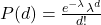
Here,  is the mathematical constant (about 2.718). By convention,
  and
and  . This means the probability of zero events is simply
  .
.
Key Properties
- Mean number of events =
- Standard error of the number of events =

In practice, since is often unknown, we estimate it using the observed number of events, d. The estimated standard error then becomes  .
.
Worked Example
Imagine you manage a maternity ward that currently receives about 4 admissions per day. The unit can handle up to 10 admissions in one day. Now suppose another maternity ward closes, and your unit is expected to receive about 6 admissions per day on average. You want to know how often your capacity of 10 will be exceeded.
To solve this, you calculate the probability of having 11 or more admissions in one day. The easiest way is to compute the probabilities of 0 through 10 admissions and subtract their sum from 1. Each probability uses the Poisson formula. For example, the probability of observing 3 admissions is:

When all values up to 10 are added, the total probability is about 0.953. Subtracting this from 1 gives 0.047, which means the ward will exceed capacity about 4.7 percent of the days, or roughly 17 days in a year.
Probabilities for Admissions per Day (Mean = 6.1)
| Admissions (d) | Probability |
|---|---|
| 0 | 0.0022 |
| 1 | 0.0137 |
| 2 | 0.0417 |
| 3 | 0.0848 |
| 4 | 0.1294 |
| 5 | 0.1579 |
| 6 | 0.1605 |
| 7 | 0.1399 |
| 8 | 0.1066 |
| 9 | 0.0723 |
| 10 | 0.0440 |
| Total (0–10) | 0.9530 |
| 11 or more | 0.0470 |
The Shape of the Poisson Distribution
The Poisson distribution changes its appearance depending on the value of . When is small, the distribution is skewed to the right. There is a relatively high probability of seeing zero or very few events. As gets larger, the distribution becomes more symmetric.
By the time reaches 10 or more, the Poisson distribution looks very much like a normal distribution. In such cases, we often use the normal approximation for easier calculations.
Using Poisson for Rates
The Poisson distribution is especially useful for analyzing rates. For instance, if you want to know how often a rare disease occurs per 1000 people per year, the number of observed cases will often follow a Poisson pattern. The connection between counts and rates is straightforward, since the Poisson mean represents the expected number of events.
This makes it possible to compare groups or time periods. For example, if two towns have different numbers of malaria cases but also different populations, using Poisson based rates allows for fair comparison.
Real World Applications
Here are some common uses of the Poisson distribution in biostatistics and public health:
- Counting the number of new cases of a congenital disorder per year in a stable population.
- Modeling the number of accidents occurring at a busy intersection in one month.
- Estimating the demand for hospital beds per day in a district health system.
- Measuring how many parasites or bacteria are observed per microscope field when examining biological samples.
All of these examples share the same assumption: events happen independently and at random. If clustering occurs, a different statistical model is required.
Limitations of the Poisson Model
While powerful, the Poisson distribution has its limits. It assumes that the mean equals the variance, which may not hold in real life. Some diseases cluster geographically or in families, violating independence. In these cases, you may observe more variability than the Poisson distribution predicts, a situation called overdispersion.
Researchers use statistical tests to check for clustering in time or space. For example, when unusual clusters of leukemia or rare neurological diseases appear in one town, the assumption of randomness is questioned. In such cases, methods beyond Poisson are required.
As a researcher or health professional, understanding the Poisson distribution helps you make better decisions about resources, risks, and planning. Whether you are estimating the number of patients in a hospital, the cases of a disease in a community, or the number of defects in a batch of manufactured goods, the Poisson model gives you a simple yet powerful way to analyze counts of random events.
The ability to approximate rare events accurately is one of the great strengths of this distribution. By applying it carefully, you gain both insight and practical guidance in real-world biostatistical problems.