
Imagine you are tracking the spread of gonorrhea in a sexually active community. You want to know how the number of infected people changes over time, accounting for both new infections and recovery. The logistic equation, often introduced in population growth studies, naturally appears in this setting too.
Setting Up the Model
We divide the population into two groups:
- Susceptible individuals:
 , sexually active but not infected.
 - Infected individuals:
 , sexually active and infectious.
The total number of sexually active individuals is:

The key assumptions are:
- New sexually active individuals enter at a rate
 , all initially susceptible.
 - Individuals leave the sexually active group at the same rate .
- Infected individuals recover and return to the susceptible group at a rate
 .
. - New infections occur at an incidence rate
 .
.
Deriving the Incidence Rate
We require that if there are no susceptibles or no infectives, new infections stop:

The incidence rate should be proportional to both susceptibles and infectives:

Define:
 = average number of sexual partners per individual per unit time
 = average number of contacts per partner
The total contacts by susceptibles per unit time are:

Under random mixing, the fraction of these contacts with infectives is:

So, the contacts between susceptibles and infectives per unit time are:

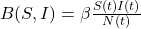
If  is the probability of transmission per contact, then the transmission rate is:

Thus the incidence rate is:
The Full Model
We now have:


Since births and deaths balance,  , and
, and  is constant.
Reducing to a Single Equation
Substitute  into the infected equation:

Which simplifies to:

Factor  :
:
![\frac{dI}{dt} = \left[ \beta - (\mu + \gamma) \right] I \left( 1 - \frac{I}{N} \right)](https://biopharmafoundry.com/wp-content/ql-cache/quicklatex.com-23bdac7a053ff06497daac36df17bb23_l3.png "Rendered by QuickLaTeX.com")
Introducing the Basic Reproduction Number
We define:

If  , the infection spreads and persists. If
  , it dies out.
Rewriting the equation:

Logistic Form
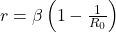
Let:
 ,
,
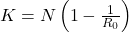
The equation becomes:

This is the classic logistic equation.
Interpretation
- If :
 ,
,  , and
, and  . The disease reaches an endemic level.
 - If : The only meaningful equilibrium is
 , the disease disappears.
Example
Suppose:

 per year
 per year
 partners per year
 contacts per partner
 transmission probability
First, compute:

Then:

Since , the infection persists, and:

About 792 individuals will be infected long-term if no intervention occurs.
Why the Logistic Equation Fits
In epidemiology, the logistic form appears when:
- The total population is constant.
- Infection rates depend on interactions between susceptible and infected individuals.
- Recovery or death removes people from the infected group.
- There is a natural limit to infection spread due to finite susceptibles.
Key Takeaways
- The logistic equation is useful beyond population growth, especially in modeling endemic infections.
- The parameter
 is critical for predicting persistence.
 - Endemic levels can be predicted and used for public health planning.
- Accurate parameter estimation from data is essential.